Deployment
Where HALEU Comes From: The Fuel Supply Behind Advanced Reactors
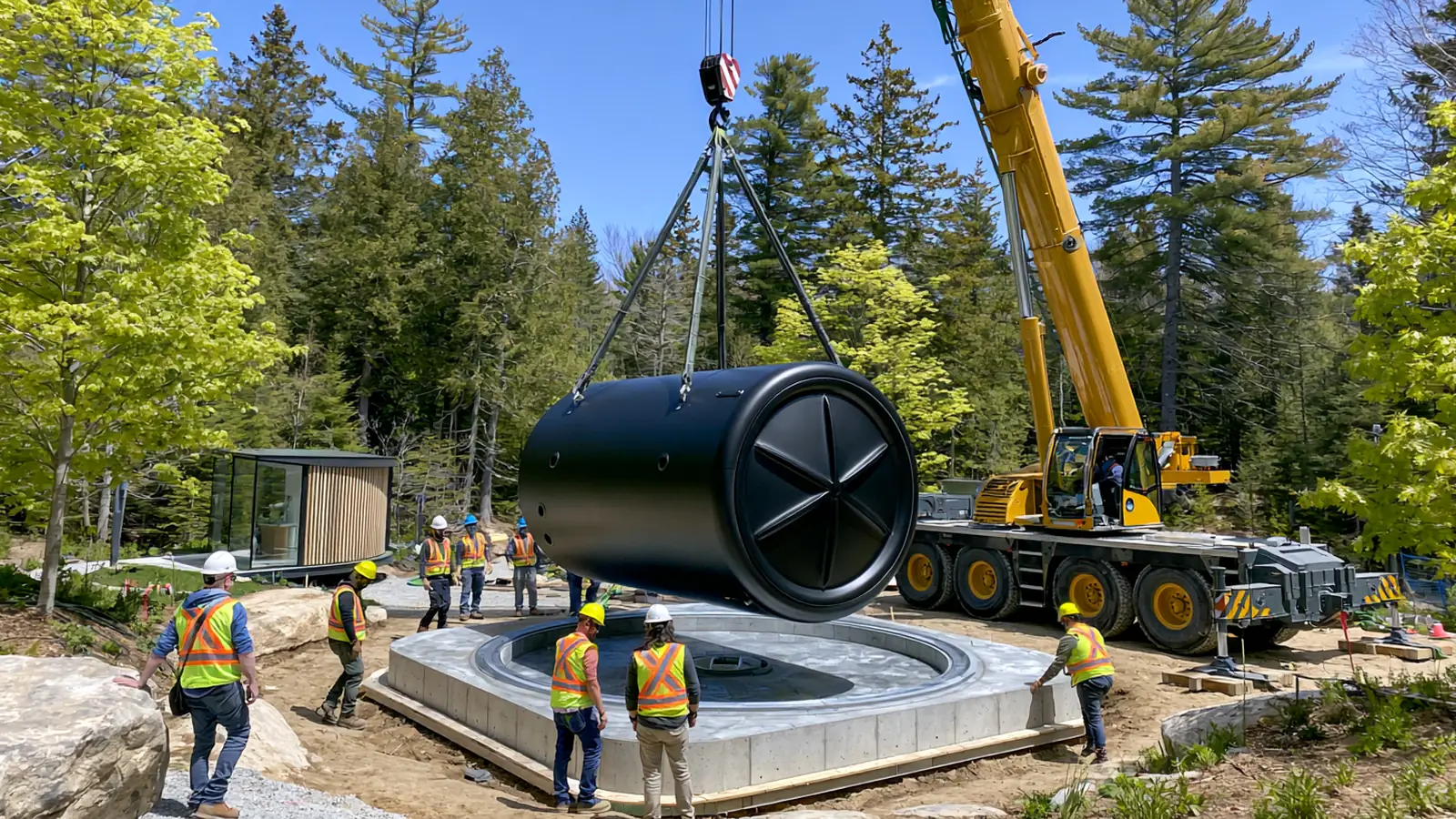
Most advanced reactor designs need a fuel called high-assay low-enriched uranium, or HALEU: uranium enriched above the assay used by today's commercial fleet and below the line that separates low-enriched from highly enriched material. The physics of using it is well understood and has been studied for decades. The binding constraint is supply. Fuel belongs in every honest project schedule as a first-order input with named suppliers and named dates, not as a footnote to be resolved later.
The supply picture has three parts that are easy to run together and should not be. Federal auditors reported in September 2022 that HALEU was not then available at commercial scale from domestic suppliers [10]. Congress responded with a statutory program directing the Department of Energy to support availability of the material [4]. And DOE now runs a published process for allocating the limited quantities that exist to developers who apply for them [5]. An authorization, an allocation, and delivered material are three different things.
This article covers what HALEU is and how DOE defines it, why compact long-cycle designs need higher assay, where supply actually stands, the statutory basis for the availability program, what the allocation rounds reveal about demand, how domestic enrichment is scaling, why fabrication and qualification are separate bottlenecks from enrichment, and how to read fuel in a project schedule. RankShield Energy is a pre-applicant holding no license, permit, or design approval [16], and the closing section applies all of it to us.
Key takeaways
- HALEU is uranium enriched above roughly 5 percent and below 20 percent, though DOE states the upper bound two different ways across its own pages.
- Higher assay is a packing solution: smaller cores running longer between refuelings need more fissile material in less volume.
- The physics is settled; supply is the constraint. GAO reported in 2022 that HALEU was not available at commercial scale from domestic suppliers.
- DOE allocation rounds are evidence of scarcity: an allocation process is what you build when demand exceeds what exists.
- Enrichment, fabrication, and qualification are three separate schedules, and a project is fuel-ready only when all three land.
HALEU is uranium enriched above 5 percent, and DOE states the upper bound two different ways
High-assay low-enriched uranium is uranium whose uranium-235 content sits above the assay used by the existing commercial fleet and below the line that separates low-enriched from highly enriched material. DOE's explainer defines it as enriched to greater than 5 and less than 20 weight percent uranium-235, and notes that today's commercial light-water reactors run on uranium enriched up to about 5 percent [1]. DOE's HALEU frequently asked questions page uses that same greater-than-5-and-less-than-20 phrasing [2].
DOE's HALEU Enrichment Services page describes the same material as enriched to between 5 and 19.75 percent [3]. Those two statements are not identical, and the difference is not a typographical accident. One states an open band up to a regulatory boundary. The other states a band that stops at a specific assay below that boundary.
We are flagging this because we ran the primary sources side by side rather than taking one page as the whole answer, and it is the kind of detail that gets lost when writers paraphrase a definition from memory. For a reader orienting to the topic, either phrasing is close enough to be useful. For a schedule assumption, a procurement document, or anything that will end up in front of a regulator, the two are not interchangeable, and the honest move is to cite the specific page you took the number from rather than presenting a single tidy figure as though DOE speaks with one voice on it.
The practical takeaway is small but real. When you see the HALEU band written a particular way in a vendor deck or a news article, check which federal page it traces to. Consistency between a claim and its source is the cheapest available signal of how carefully the rest of the document was assembled.
Compact designs with long operating cycles need higher assay to carry enough fissile material
The reason so many advanced designs converge on HALEU is a packing problem rather than an exotic one. A smaller core has less room for fuel, and a core intended to run a long interval between refuelings has to hold enough fissile material at the start to sustain the chain reaction all the way to the end of that interval. Raising the assay is how designers get more uranium-235 into a given volume. DOE puts the consequence plainly: higher-assay fuel supports smaller plant designs, longer operating cycles, and higher efficiencies than the existing fleet achieves on conventional low-enriched fuel [1].
That design logic is what produced the microreactor class in the first place. GAO's technology spotlight describes nuclear microreactors as small, factory-fabricated units intended to be transportable and to operate for extended periods, and identifies the fuel they generally require as high-assay low-enriched uranium [11]. The fuel choice is not a preference bolted onto the concept. It is upstream of the concept.
DOE's microreactor program plan reflects the same ordering. The program is organized around technical areas that include fuel alongside the reactor technologies themselves, which is a signal that federal program managers treat fuel development as program-level work rather than as a downstream procurement task to be handled once a design is finished [15].
The consequence for anyone reading design literature is that the assay decision drags a whole supply chain behind it. A design that needs HALEU does not simply need uranium. It needs enrichment capacity configured for that band, a fabricator able to make its specific fuel form, and a qualification record a regulator will accept. Each of those is a separate organization, a separate schedule, and a separate way for a project to slip.
The binding constraint today is supply, and the federal government is the main route to material
The physics of using higher-assay fuel is well understood. The constraint is that there is not much HALEU available to buy. GAO reported in September 2022 that "The primary source of commercially available HALEU today is from Russia," and that the material "is not currently available at commercial scale from domestic suppliers" [10]. That report is now several years old and the domestic picture has moved since, which is exactly why the date matters when the sentence gets quoted. Read it as a description of the starting position rather than as a live snapshot.
GAO had flagged the broader vulnerability earlier still, finding in December 2020 that risks to the domestic uranium supply chain needed better planning and coordination across the agencies responsible for them [12]. The HALEU shortfall is a specific instance of a supply-chain problem that federal auditors had already named in general terms.
Today the practical route to material for most U.S. advanced reactor developers runs through the Department of Energy rather than through an open commercial market. DOE stood up an allocation process for distributing limited quantities of HALEU to developers [5], which is the arrangement you build when demand exceeds what is available. Meanwhile domestic output remains modest in absolute terms: DOE-NE reported that cumulative U.S. HALEU production reached 900 kilograms by the end of June 2025 [8].
It helps to see the whole chain at once, because the conversation usually collapses into enrichment alone when enrichment is only the first of several gates.
| Stage | What it requires | Where it stands in the cited record |
|---|---|---|
| Enrichment above 5 percent | Operating enrichment capacity licensed and configured to produce assays above the roughly 5 percent used by the existing fleet | GAO reported in September 2022 that HALEU was not then available at commercial scale from domestic suppliers [10]. DOE-NE reported cumulative U.S. production of 900 kilograms by the end of June 2025 from a 16-centrifuge cascade in Piketon, Ohio [8]. |
| Access to material | A route to obtain quantities, which for most developers today runs through a federal program rather than an open commercial market | DOE established a published allocation process [5] under the HALEU Availability Program [4], and has announced conditional commitments in successive rounds [6][7]. |
| Fuel fabrication | Production lines able to turn enriched material into the specific fuel form a given design uses, at rate and to specification | DOE selected four companies for advanced nuclear fuel line pilot projects in September 2025 [9], which is a signal that domestic fabrication capacity was still being stood up. |
| Fuel qualification | Irradiation testing and a documented performance dataset that a regulator can review for the form and conditions in question | The DOE Advanced Gas Reactor program was established to develop and qualify TRISO fuel and to produce that dataset [14]. DOE reports that the AGR-1 experiment reached 19 percent peak burnup with zero particle failures [13]. |
Every row in that table is a separate industrial capability with its own lead time. A project is not fuel-ready when one of them clears. It is fuel-ready when all of them do, for its specific fuel form, on dates that line up.
The HALEU Availability Program exists because Congress directed it
The federal effort here is not discretionary enthusiasm. DOE describes the HALEU Availability Program as established by section 2001(a)(1) of the Energy Act of 2020, with the purpose of supporting the availability of HALEU for civilian domestic demonstration and commercial use [4].
Congress then attached a quantity and a schedule. DOE notes that section 3131(h) of the National Defense Authorization Act for Fiscal Year 2024 set a schedule under which the Department is to seek to make available 21 metric tons of HALEU [4]. That is a directive to seek to make material available, which is a meaningfully different thing from a delivered inventory, and the statutory language is worth reading in exactly those terms.
The program also has an operational face. DOE contracts for HALEU enrichment services as one of the mechanisms for building domestic capability [3], and publishes the process by which available material is allocated to applicants [5]. Together those give the field something it did not have before: a defined, documented route to request material, with published criteria, rather than an informal queue.
The honest reading of a statutory program is that it tells you what the government has committed to attempt, on what timeline, and under what authority. It does not tell you that the material exists. Both facts can be true at once, and a project schedule that quietly converts the first into the second has introduced an assumption its own authors may not notice. When you see a developer point to the HALEU Availability Program as evidence that fuel is handled, the follow-up question is whether they are pointing at an authorization or at an allocation, because those are different objects.
Two allocation rounds show demand running ahead of available material
The allocation record is the clearest public evidence of the imbalance, because it shows how many parties asked and how many were served. In April 2025 DOE announced conditional commitments in its initial round to TRISO-X, Kairos Power, Radiant Industries, Westinghouse and TerraPower, and reported that 15 companies had requested HALEU [6]. In August 2025 DOE announced a further round of conditional commitments to Antares Nuclear, Standard Nuclear, and Abilene Christian University together with Natura Resources [7].
To be explicit about what that paragraph is and is not: it is factual reporting of two Department of Energy announcements. This article does not rank, score, rate, or compare any of the companies named, and nothing about appearing in a DOE round should be read here as an endorsement of a design, a schedule, or an organization. We name them because the composition of the rounds is public information that a reader evaluating the supply picture is entitled to have.
The structural signal is in the arithmetic rather than the names. An allocation process gets built when a resource is scarce enough that it has to be rationed, and DOE published one [5]. More companies requested material than received commitments in the initial round [6]. And the commitments themselves are conditional, which means conditions attach before material moves.
Read alongside the statutory target [4], the rounds describe a federal program doing what it was directed to do, at a scale set by what is actually available rather than by what the field would like. That is not a criticism of the program. It is the reason fuel deserves a line on a project schedule instead of a footnote.
Domestic enrichment is scaling up, and the published numbers show how early it is
The most concrete public marker of domestic progress is the Piketon, Ohio cascade. DOE-NE reported that cumulative U.S. HALEU production reached 900 kilograms by the end of June 2025, produced by Centrus from a 16-centrifuge cascade [8]. That is a real, verified, domestically produced quantity where a few years earlier there was effectively none.
Set that against projected need. DOE-NE has estimated that domestic HALEU demand could reach 50 metric tons per year by 2035 [8]. The two figures are not the same kind of measurement and should not be subtracted from one another. One is cumulative output through a date. The other is a projected annual requirement roughly a decade out. Stated in common units, 900 kilograms is 0.9 metric tons of cumulative production, against a projection of 50 metric tons required each year. What the pair describes is the distance between where domestic production had reached and where projected demand sits, and the number of doublings implied by closing it.
The scale-up mechanism is partly contractual. DOE procures HALEU enrichment services as one way of building the domestic capability the statute directs it to pursue [3], under the availability program Congress established [4]. A 16-centrifuge cascade is a demonstration-scale machine, and moving from demonstration scale to the throughput implied by tens of metric tons per year is a capital, licensing, and construction problem rather than a scientific one.
None of this contradicts GAO's September 2022 finding about the starting position [10]. It refines it. The domestic capability that GAO reported as absent at commercial scale now exists at demonstration scale and is producing measurable output. Whether it arrives at commercial scale in time for any particular project is a schedule question, and the answer is specific to that project rather than general to the industry.
Fabrication and qualification are separate bottlenecks from enrichment
Enriched uranium is not fuel. A reactor needs fuel elements in a specific geometry and chemical form, fabricated to specification, made on a line that can produce them at rate. That is a distinct industrial capability from enrichment, run by different organizations, and it can bind a schedule even when material is available. DOE selected four companies for advanced nuclear fuel line pilot projects in September 2025 [9], which tells you domestic fabrication capacity for advanced fuel forms was still being established at that point.
Qualification is a third gate. For the TRISO fuel form, DOE describes a design in which a uranium kernel is surrounded by three layers of carbon and silicon carbide, so that each particle functions as its own containment system, and reports that the particles have been tested to 1,800 degrees Celsius with low fission product release [13]. DOE also reports that the AGR-1 experiment reached 19 percent peak burnup with zero particle failures [13], results generated within the DOE Advanced Gas Reactor Fuel Development and Qualification Program, which was established to develop and qualify the fuel form and to build the performance dataset that supports it [14].
Two qualifications on that paragraph, both of which matter. First, those are DOE's characterizations of a fuel form under test conditions, not a safety finding about any particular reactor. A robust fuel form is an input to a safety case, never a substitute for one, and the passive safety claims that get made about advanced designs remain subject to analysis, testing, and NRC review for each specific design. Second, a qualification dataset covers the conditions it was generated under. A design operating outside that envelope inherits the testing burden rather than the conclusion.
This is also where the microreactor program plan's treatment of fuel as program-level work reads as sound program management rather than bureaucratic hedging [15]. Enrichment, fabrication, and qualification are three schedules that all have to land, and only one of them is the one everybody talks about.
How to read fuel in a developer's schedule, including ours
Fuel is where optimistic schedules go to become real, so it is worth a short list of questions that separate a plan from an intention. Which specific fuel form does the design use? Has that form been fabricated at production rate by an identified supplier, or does it exist as a laboratory or pilot article? What qualification dataset covers it, and does the design operate inside the conditions that dataset actually spans? Is there an allocation, a conditional commitment, or a commercial contract, and which one? And what does the schedule do if fuel arrives late, since a design that has no answer there has embedded a single point of failure it has not disclosed.
Those questions belong next to the ones in our vendor evaluation guide, and they bear directly on the speed-to-power case for data centers, because a fuel date that slips moves an energization date with it no matter how well the rest of the project is run. A developer who cannot separate an authorization from an allocation on their own schedule has not done this work.
Applied to us, unsentimentally. RankShield Energy is a pre-applicant engaged in early interaction with the U.S. Nuclear Regulatory Commission [16]. We hold no license, permit, or design approval, and nothing about our design has been demonstrated to or accepted by the NRC. We have not secured HALEU supply, we hold no DOE allocation, and we are not named in any allocation round [5]. HALEU supply is a real constraint on our schedule exactly as it is for the rest of the field, and we would rather write that down than imply otherwise by omission.
Our position, stated so it can be argued with: fuel belongs in the schedule as a first-order input with named suppliers, named dates, and a stated fallback, not as an assumption in a footnote. That is a harder document to write and an easier one to check, which is the tradeoff we are choosing. If you want the regulatory half of the same picture, our explainer on how NRC pre-application works covers what a pre-applicant can and cannot claim.
Frequently asked questions
What exactly is HALEU?
High-assay low-enriched uranium is uranium with a higher uranium-235 content than the fuel used by today's commercial light-water reactors, which run on uranium enriched up to about 5 percent. DOE's explainer defines HALEU as enriched to greater than 5 and less than 20 weight percent uranium-235 [1], and its frequently asked questions page uses the same phrasing [2]. Worth knowing: DOE's HALEU Enrichment Services page states the band as between 5 and 19.75 percent [3]. Both descriptions come from the Department of Energy, so cite the specific page you are relying on rather than treating one number as settled.
Why do advanced reactors need higher-assay fuel?
It is a packing problem. A smaller core has less volume for fuel, and a longer interval between refuelings requires more fissile material loaded at the start. Higher assay is how designers fit enough uranium-235 into the space available. DOE states that higher-assay fuel supports smaller plant designs, longer operating cycles, and higher efficiencies [1], and GAO's technology spotlight identifies HALEU as the fuel the microreactor class generally requires [11]. The fuel choice sits upstream of the design concept rather than downstream of it.
Is there enough HALEU available today?
Not at commercial scale from domestic suppliers, on the public record. GAO reported in September 2022 that HALEU was not then available at commercial scale from domestic suppliers and that the primary source of commercially available material was Russia [10]; note the date, because the domestic picture has moved since. DOE-NE reported cumulative U.S. production of 900 kilograms by the end of June 2025 from a 16-centrifuge cascade, against a DOE-NE estimate that domestic demand could reach 50 metric tons per year by 2035 [8]. Those are different kinds of figure, one cumulative and one annual, and the gap between them is the reason a federal allocation process exists.
What is the HALEU Availability Program?
It is the federal program DOE describes as established by section 2001(a)(1) of the Energy Act of 2020 to support the availability of HALEU for civilian domestic demonstration and commercial use, with section 3131(h) of the FY2024 National Defense Authorization Act setting a schedule under which the Department is to seek to make 21 metric tons available [4]. In practice it operates through enrichment services contracting [3] and a published allocation process for distributing limited quantities to applicants [5]. A statutory directive to seek to make material available is not the same as material in hand, and it is worth keeping those separate when reading anyone's schedule.
Does RankShield Energy have HALEU supply secured?
No. We have not secured HALEU supply, we hold no DOE allocation, and we are not named in any DOE allocation round [5]. RankShield Energy is a pre-applicant engaged in early interaction with the NRC, holding no license, permit, or design approval, with nothing about our design demonstrated to or accepted by the NRC [16]. Fuel supply is a genuine constraint on our schedule in the same way it is for other developers working in this class, and we would rather state that directly than let silence imply a position we have not earned.
Sources
- U.S. Department of Energy, Office of Nuclear Energy. What is High-Assay Low-Enriched Uranium (HALEU)?. December 2024
- U.S. Department of Energy, Office of Nuclear Energy. HALEU Frequently Asked Questions. Accessed July 2026
- U.S. Department of Energy, Office of Nuclear Energy. HALEU Enrichment Services. Accessed July 2026
- U.S. Department of Energy, Office of Nuclear Energy. HALEU Availability Program. Accessed July 2026
- U.S. Department of Energy. High-Assay Low-Enriched Uranium (HALEU) Allocation Process. August 2025
- U.S. Department of Energy. U.S. Department of Energy to Distribute First Amounts of HALEU to U.S. Advanced Reactor Developers. April 2025
- U.S. Department of Energy. U.S. Department of Energy to Distribute Next Round of HALEU to U.S. Nuclear Industry. August 2025
- U.S. Department of Energy, Office of Nuclear Energy. Centrus Reaches 900 Kilogram Mark for HALEU Production. June 2025
- U.S. Department of Energy. Energy Department Selects Four Companies for Advanced Nuclear Fuel Line Pilot Projects. September 2025
- U.S. Government Accountability Office. Nuclear Energy Projects: DOE Should Institutionalize Oversight Plans for Demonstrations of New Reactor Types (GAO-22-105394). September 2022
- U.S. Government Accountability Office. Science and Tech Spotlight: Nuclear Microreactors (GAO-20-380SP). February 2020
- U.S. Government Accountability Office. Uranium Management: Actions to Mitigate Risks to Domestic Supply Chain Could Be Better Planned and Coordinated (GAO-21-28). December 2020
- U.S. Department of Energy, Office of Nuclear Energy. TRISO Particles: The Most Robust Nuclear Fuel on Earth. Updated June 2023
- Idaho National Laboratory. DOE Advanced Gas Reactor Fuel Development and Qualification Program (INL/MIS-23-75732). December 2023
- Idaho National Laboratory / U.S. Department of Energy. A Microreactor Program Plan for the Department of Energy (INL/EXT-20-58919 Rev. 4). May 2025
- U.S. Nuclear Regulatory Commission. Pre-Application Activities for Advanced Reactors. Accessed July 2026
This guide reflects the state of HALEU supply and advanced-reactor fuel programs as of July 2026. This area is moving quickly. Check back if the Department of Energy or the NRC issues new allocations or guidance.
About this article. RankShield Energy is a pre-applicant engaged in early regulatory interaction with the U.S. Nuclear Regulatory Commission (NRC). Nothing here should be read as a representation that any RankShield Energy design, product, or facility is NRC-approved, licensed, or certified, or that any safety, performance, or operational characteristic has been demonstrated or accepted by the NRC. Descriptions of reactor and system behavior reflect design intent and are subject to analysis, testing, and regulatory review. This article is for general educational purposes and is not engineering, legal, regulatory, or investment advice.
A note on how we write about our own reactor
HELIX is in pre-application development. Where this article touches our design, every figure is a design target and every physics result is unqualified screening, labeled as such. We cite authoritative sources (NRC, DOE, IAEA, national laboratories) and never invent statistics.
RankShield Energy · HELIX · pre-application