Verification & trust
The Digital Twin as a Verification Layer for Remote Reactor Operations
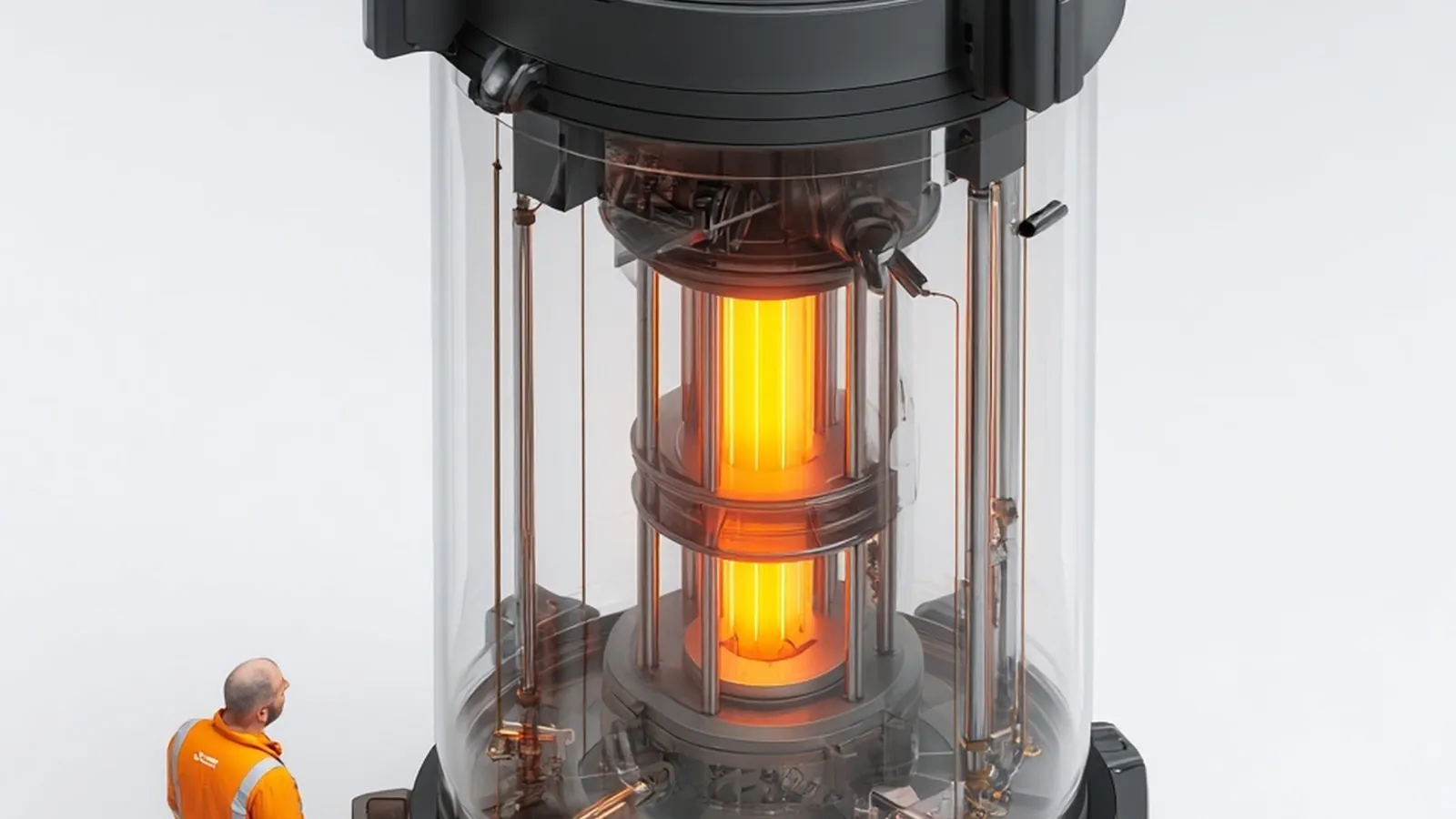
A digital twin becomes a verification layer, rather than a simulation, when an independent party uses it to confirm that a reactor’s reported state matches what its physics and its design permit, and records that confirmation so someone outside the control room can check it later. A twin that only mirrors the operator’s own model reassures the operator. A twin used as an independent check tells an outsider something they can rely on. The difference is who runs it.
"Digital twin" now appears in nearly every advanced-reactor pitch, usually offered as proof that the vendor understands its own machine. Understanding your own machine is table stakes. The harder question, for a reactor designed to run remotely and with fewer people on site, is whether the twin can tell an outside party something that party can trust. In July 2026 Idaho National Laboratory and university partners demonstrated remote, real-time autonomous power control of a research reactor, with the reactor's safety systems retaining control throughout the test [4]. The MARVEL microreactor experiment pairs remote monitoring with a digital twin that supports operator functions [2], and proposed federal rules now contemplate exactly this kind of remote, reduced-staffing operating model [10].
This article is educational. It sets out what separates a twin that simulates from a twin that verifies, why that separation depends on who owns the twin, what the standards world already worked out about independent checking, why remote and autonomous operation raises the stakes, and what has actually been demonstrated so far. The part most vendor material skips is the last one. RankShield Energy is a pre-applicant with the U.S. Nuclear Regulatory Commission, engaged in early regulatory interaction and holding no license or approval; the closing section applies the argument to us as unsentimentally as to anyone else.
Key takeaways
- A twin that mirrors the operator's own model is simulation; a twin that confirms measured reactor state against model and design limits is verification.
- Verification requires closing the loop: read live measurement, compare it against what the model and design permit, and record any divergence.
- Independence is structural, not intentions: a vendor-internal twin is self-attestation, because the party being checked owns the checker.
- The attestation standards world already split evidence, independent appraisal, and durable records; a verifying twin can borrow that machinery.
- As on-site presence thins under remote-operation rules, more of the safety story rests on self-report, making an independent check more load-bearing, not less.
Simulation and verification answer opposite questions
A simulation predicts what a reactor should do. A verification layer confirms what the reactor is actually doing. The two use similar math and are easy to conflate, but they point in opposite directions, and a digital twin can be built to serve either one.
A simulation runs the model forward and produces an expected state. It is a forecast. Verification starts from the reactor's reported state and asks whether that state is consistent with the model, the sensors, and what the design permits. It is a check on reality. A twin used purely as a design, training, and monitoring tool is a high-fidelity simulation, and a valuable one. DOE reported that Idaho National Laboratory demonstrated a digital twin of a simulated microreactor that predicted the system's thermal behavior and then autonomously controlled it, which is exactly the forecast-and-act pattern a design twin is good at [1]. National-lab work also shows a twin operating alongside remote monitoring in the MARVEL experiment, where the twin is meant to support operator functions rather than replace human oversight [2].
The problem is that a simulation which agrees with the operator's own assumptions cannot, on its own, tell an outside party that the physical reactor is behaving. It can only tell you the model is internally consistent. To become verification, the twin has to be fed live measurement and made to disagree when the measurement and the model diverge. Not a mirror of the operator's model. A check on it. That shift, from forecasting an expected state to confirming an observed one, is the whole distinction this article is built on, and most vendor material blurs it.
Closing the loop between measured and modeled state
A digital twin verifies reactor state by closing the loop between measured and modeled state. That means three things happen continuously: the reactor is measured, the measurement is compared against what the model and the design allow, and the comparison is recorded so it can be checked later. A twin that skips any of the three is forecasting, not verifying.
First, live measurement. Temperatures, power level, control positions, and the status of safety functions are read from the reactor itself. Oak Ridge National Laboratory, surveying what autonomous microreactor operation would require, named the preconditions plainly: sensor and instrumentation technologies capable of long-term unattended operation, complete awareness of system state, and control approaches that can act on that awareness [3]. None of the downstream verification works if the measurement layer is thin. Second, comparison. The twin computes what the measured quantities should be, given the model and the commands the reactor received, and flags where measured and modeled values disagree beyond an expected margin. Third, recording. The comparison, and any divergence, is written to a tamper-evident record that a regulator, insurer, or lender can inspect afterward. The path from raw signals to that durable record is its own engineering problem, which we walk through in turning reactor state into an attestation record.
The value of closing the loop is that disagreement becomes visible. A twin that only forecasts will produce a clean-looking state whether or not the hardware agrees with it. A twin that continuously compares measured against modeled state surfaces the gap the moment it opens. When Idaho National Laboratory demonstrated remote, real-time autonomous power control of a research reactor in July 2026, the reactor's safety systems retained control throughout, which is the kind of live, closed-loop operating context in which a verifying twin has to function [4].
The independence question: whose twin does the verifying
Closing the loop is necessary but not sufficient. The remaining question is who owns the twin doing the checking. If the operator builds, runs, and interprets its own digital twin, that twin is part of the operator's self-report, however good the engineering is. It is the operator grading its own work, and an outside party has no independent basis to rely on the grade.
Independence here is structural, not a matter of good intentions. A verification result carries weight for a lender, insurer, or regulator only when the party producing it is separate from the party being checked, so the checker has no stake in the reactor looking good. Nuclear already supplies this separation with people rather than software. The NRC stations resident inspectors at operating plants, at least two per site, and describes their function as independently verifying that requirements are being met [12]. The word independently is doing specific work in that sentence: the inspector is not a better observer than the operator, but a differently positioned one. The same reasoning is what separates a twin that reassures from a twin that verifies, and it is the core of self-attestation versus independent verification.
Applied to a digital twin, independence means the appraisal and the recorded result should sit with a party separate from the operator, rather than inside the operator's own software. A vendor-internal twin answers a narrow question: does our model agree with our model. An independent verification layer answers a harder one: does the reactor agree with reality, in a form someone other than the vendor can check. Those are not the same claim, and conflating them is how a simulation gets sold as an assurance. In my view, drawn from building verification systems rather than operating reactors, this distinction is the entire game, and it is the part a buyer should press hardest.
Vendor-internal twin versus independent verification twin
The cleanest way to see the difference is side by side. A vendor-internal twin and an independent verification twin can run identical physics and still produce assurances of very different value, because value here comes from who owns the checker and what an outsider can rely on, not from model fidelity. The comparison below is the test to apply to any twin a developer points to.
| Question | Vendor-internal twin | Independent verification twin |
|---|---|---|
| Who owns and runs it? | The reactor's operator or vendor | A party separate from operations |
| What does it actually answer? | Does our model agree with our model | Does the reactor agree with reality, checkably |
| Who interprets a disagreement? | The operator, privately | The independent verifier, on the record |
| What can an outsider rely on? | The operator's word | A signed appraisal a third party can check |
| Characteristic failure mode | Undetectable drift between claim and reality | Detectable divergence, with a timestamped record |
The fourth row is where most systems marketed as verification quietly fail. If the only thing an outside party ends up relying on is the operator's word, the twin added polish, not assurance. Computing formalized this split long ago: the RATS architecture defines an Attester that produces evidence, a Verifier that appraises it against a policy, and a Relying Party that acts on the Verifier's result, on the premise that one end of a link needs to know whether the other end is in an intended operating state [5]. A verification twin is that pattern applied to a reactor, with the Verifier deliberately placed outside the operator.
What the attestation standards already contribute
The independent-checking problem is not new, and the digital-twin conversation does not have to solve it from scratch. Standards bodies outside nuclear have already defined how a separate party appraises a system's reported state and how the result is recorded so anyone can check it later. A verification twin can borrow that machinery directly.
The RATS architecture supplies the roles: evidence, an independent appraisal, and a relying party who consumes the verdict rather than the raw claim [5]. The missing piece, durability, is addressed by transparency work such as SCITT, which describes an append-only, tamper-evident service that issues receipts, so a recorded appraisal can be checked later without asking the operator to vouch for it [6]. Both matter for a reactor precisely because the record needs to outlive the equipment, the software version, and possibly the vendor. On the nuclear side, the guardrails are also taking shape. The NRC has published guidance on digital instrumentation and control for advanced reactors, which is the regulatory frame any verifying twin would have to live inside [8]. The IAEA's guidance on computer security of instrumentation and control systems sets expectations for protecting that measurement and reporting chain across its life cycle, which is exactly the chain a verification twin depends on [9].
None of this is a RankShield invention, and we do not present it as one. The contribution is applying a settled pattern from computing and international guidance to reactor state, then being honest that the reactor-specific version has not been demonstrated under regulatory review. A standard tells you how independent appraisal should be structured. It does not, by itself, prove that any particular twin is doing it. That gap between an available architecture and a demonstrated capability is where careful reading of vendor claims pays off.
Why remote and autonomous operation raises the stakes
For a conventionally staffed plant, weak evidence is partly offset by presence: people on site form judgments that instrumentation misses. Thin that presence and the offset goes with it, which is why independent verification moves from good practice to something closer to a requirement as operating models change. The regulatory direction of travel makes this concrete.
Today, federal rules require a licensed operator to be present at the controls at all times [11]. The proposed 10 CFR Part 57 framework contemplates remote operation and reduced on-site staffing for microreactors, a shift explained neutrally in our walkthrough of Part 57 and autonomous operation, and it is a proposed rule, not final, that may change [10]. The national laboratories have been explicit about what this disturbs. Sandia National Laboratories, working on human factors for automating microreactors, described designs in which one control room supervises multiple reactors [14], which is the fleet-scale version of the problem and a harder one. Brookhaven National Laboratory, reviewing facilities without traditional main control rooms for the NRC, framed the safety question as verifying that important human actions can still be performed accurately and reliably [7]. Work by the NRC and Idaho National Laboratory on the human factors of offsite monitoring and remote operation points the same way [13].
Put together, the pattern is straightforward. As on-site presence decreases, the share of the safety story carried by what the system reports about itself increases. A digital twin used as an independent verification layer is one way to keep that curve from ending somewhere uncomfortable, because it puts a separate party between the reactor's self-report and the outside world that has to act on it. Reactivity and safety actions still keep a human in the loop; the twin adds assurance about what is reported, not unsupervised control.
What has actually been demonstrated, and where it is thin
The honest state of the field is that the operating model is being demonstrated faster than the independent-verification layer for it is being built. That asymmetry is the single most important thing a reader should take from this post, because it is the part vendor decks tend to skip.
On the capability side, the results are real and attributable to the labs. DOE reported that Idaho National Laboratory demonstrated a digital twin of a simulated microreactor that forecast the system's behavior and then autonomously controlled it [1]. In July 2026, INL and university partners demonstrated remote, real-time autonomous power control of a research reactor, with safety systems retaining control throughout [4]. The MARVEL experiment pairs a twin with remote monitoring to support operator functions [2]. These are national-lab results, not demonstrations of any commercial reactor's safety, and none of them is RankShield Energy's result.
A fair counterargument is that a sufficiently rigorous vendor-internal twin, audited by regulators, delivers the same assurance without a separate verifier, so the independence point is overstated. The response is that regulatory audit is itself an external check, which proves rather than refutes the point: the assurance comes from a party outside operations, whether that party is an inspector, an auditor, or an independent verifier. Removing the external party is what weakens the claim, not adding one. The honest limitation is that turning demonstrated remote-operation capability into an independent, buyer-facing verification layer, one an outsider can rely on without asking the vendor to vouch for itself, is still in progress across the industry, including at RankShield Energy. Anyone presenting a digital twin as settled proof that an autonomous reactor is safe is overstating where the field is; the accurate framing, for every serious developer, remains design intent subject to analysis, testing, and NRC review. How a buyer should probe a reported state is the subject of verifying an autonomous microreactor.
Applying this at RankShield, honestly
RankShield Energy treats the independent verification twin as an architecture it applies, not a capability it has deployed or certified. We are a pre-applicant with the NRC, engaged in early regulatory interaction, and we hold no license, permit, or design approval. We have never operated a reactor, and nothing about our approach has been demonstrated to or accepted by the NRC.
What we actually build toward is the separation described throughout this post: an appraisal of reactor state, and the recorded result of that appraisal, sitting with a party structurally distinct from whoever operates the reactor, so that confirming a reported change does not depend on the operator's word. Our real working expertise is in the verification engineering, the signing, the transparency logging, and the independent-appraisal design, not in operating nuclear plants, and we try to keep that line bright. The same separation applies to the harder question of trusting a remotely operated reactor's command state, which a verifying twin only partially addresses.
Stated so it can be argued with: a vendor cannot be its own independent verifier, and that remains true of us, which is why we treat the separation as structural rather than as a feature to bolt on later. The tradeoff is genuine. A separate verifier adds a party to coordinate with and creates a body that can contradict us in public, and we think that last property is the point rather than a defect. If you are evaluating developers on any of this, apply the questions in our vendor evaluation guide to us as unsentimentally as to anyone else.
Frequently asked questions
What is the difference between a simulation and a digital twin used for verification?
A simulation predicts what a reactor should do; a verification twin confirms what the reactor is actually doing and records the result so it can be checked later. Every verifying twin contains a simulation, but not every simulation verifies anything. A twin that only runs the model forward, without being fed live measurement and made to disagree when measurement and model diverge, is a forecast. DOE has reported national-lab work where a twin predicted a simulated microreactor's behavior and then acted on it, which is the forecast-and-act pattern rather than the check-against-reality pattern [1].
Can a vendor's own digital twin count as independent verification?
No, not on its own. A vendor-internal twin is run and interpreted by the same party that operates the reactor, which makes it a form of self-attestation: the operator grading its own work. For an outside party such as a regulator, insurer, or lender, the result carries weight only when the appraising party is structurally separate from the operator. Nuclear already supplies that separation with people; the NRC describes its resident inspectors as independently verifying that requirements are being met [12]. An independent verification twin applies the same logic in software.
What does closing the loop between measured and modeled state mean?
It means the twin continuously does three things: reads live measurement from the reactor, compares that measurement against what the model and the design permit, and records any divergence in a tamper-evident form. A twin that skips the measurement or the recording is forecasting, not verifying. Oak Ridge National Laboratory named the preconditions for this, including sensors capable of long-term unattended operation and complete awareness of system state [3]. Closing the loop is what makes a disagreement between claim and reality visible instead of silent.
Why does remote or autonomous operation make an independent twin more important?
Because on-site presence was quietly doing part of the assurance work. Current rules require a licensed operator at the controls at all times, while the proposed Part 57 framework contemplates remote operation and reduced staffing, a proposed rule that is not final [10]. National-lab research has described one control room supervising multiple microreactors [14]. As presence thins, more of the safety story rests on what the system reports about itself, which makes an independent check on those reports more load-bearing, not less. Safety actions still keep a human in the loop.
Does RankShield Energy have a working independent verification twin today?
No, not as a deployed or certified capability. RankShield Energy is a pre-applicant with the NRC holding no license, permit, or design approval, and we have never operated a reactor. The independent verification twin is an architecture we apply and build toward, drawing on established attestation and transparency patterns, but describing an architecture is not the same as having demonstrated it under regulatory review [10]. We would rather state that plainly than let the distinction blur, because the distinction is the entire argument.
Sources
- U.S. DOE Office of Nuclear Energy. Idaho National Laboratory Demonstrates First Digital Twin of a Simulated Microreactor. July 2022
- Idaho National Laboratory. MARVEL Project. Accessed July 2026
- Oak Ridge National Laboratory. Concepts for Autonomous Operation of Microreactors (ORNL/TM-2019/1305). September 2019
- Idaho National Laboratory. Researchers achieve remote, autonomous power control of a research reactor in real time. July 2026
- Internet Engineering Task Force. RFC 9334: Remote ATtestation procedureS (RATS) Architecture. January 2023
- Internet Engineering Task Force. RFC 9943: An Architecture for Trustworthy and Transparent Digital Supply Chains (SCITT). June 2026
- Brookhaven National Laboratory for the U.S. NRC. Review of Reactor Facilities without Main Control Rooms (BNL-227637-2025-INRE). February 2025
- U.S. Nuclear Regulatory Commission. Digital Instrumentation and Controls guidance for advanced reactors. Accessed July 2026
- International Atomic Energy Agency. Computer Security of Instrumentation and Control Systems at Nuclear Facilities (Nuclear Security Series No. 33-T). 2018
- U.S. Nuclear Regulatory Commission. Licensing Requirements for Microreactors (proposed 10 CFR Part 57). Federal Register, May 1, 2026 (91 FR 23628)
- U.S. Government Publishing Office. 10 CFR 50.54(m), Conditions of licenses. 2024 CFR edition
- U.S. Nuclear Regulatory Commission. Backgrounder on NRC Resident Inspectors Program. Accessed July 2026
- U.S. NRC and Idaho National Laboratory. Characterizing the Human Factors of Offsite Monitoring and Remote Operation for the Nuclear Domain. NPIC&HMIT, June 2025
- Sandia National Laboratories. Human Factors Considerations for Automating Microreactors (SAND-2020-5635). June 2020
This guide reflects the state of microreactor digital-twin and remote-operations work as of July 2026. This area is evolving rapidly; national-lab demonstrations are research results, not commercial approvals, and this page will be reviewed as new results are published.
About this article. RankShield Energy is a pre-applicant engaged in early regulatory interaction with the U.S. Nuclear Regulatory Commission (NRC). Nothing here should be read as a representation that any RankShield Energy design, product, or facility is NRC-approved, licensed, or certified, or that any safety, performance, or operational characteristic has been demonstrated or accepted by the NRC. Descriptions of reactor and system behavior reflect design intent and are subject to analysis, testing, and regulatory review. This article is for general educational purposes and is not engineering, legal, regulatory, or investment advice.
A note on how we write about our own reactor
HELIX is in pre-application development. Where this article touches our design, every figure is a design target and every physics result is unqualified screening, labeled as such. We cite authoritative sources (NRC, DOE, IAEA, national laboratories) and never invent statistics.
RankShield Energy · HELIX · pre-application